Sunday, May 15, 2011


Saturday, October 23, 2010
Dare to Shorten Your Tai Chi Training for 10 Years?
I learned a number of ways from Tai Chi Kung to sparing which has improved my skills dramatically.
They all work. Those are insights of different grandmasters from Chen, Yang, Wu, and Wu-Tang Tai Chi family. But, it will take another life time to just understand it.
However, I found one simple technique which is quite useful and powerful. I learned this from William C.C. Chen when I asked him about the correct way to breath.
“This is how you should breathe when doing the Tai Chi. This will shorten your Tai Chi Training for at least 10 years.”
I was amazed by what he taught me. It’s so simple yet not too many people outside of his circle will even believe him as we always want MORE. I believe it works, not because he is a big name teacher, but because I have learned similar technique when I was a kid.
This is how it works.
1. Focus on your hand when you inhale and focus on your one point (Tan Tien) when you exhale.
2. Inhale when you are raising (Open) your hand and body. Exhale when you are lowering your hand and body (Close). He called this open and close. (Note: This is the same as what has been taught in the Tai Chi Classics.)
This is it. No more struggle.
Now, you have to make a choice whether you will just ignore this technique, or incorporate it into your training and see if this will actually shorten your time of training for 10 years.
However, there is no guarantee.
“If you want a guarantee, buy a toaster.” --- Clint Eastwood
Wednesday, August 12, 2009
Let's Push Hands!
In fact, this is a polite way to challenge someone or to test your own skills in Tai Chi.
Sure, it's true that most of the great Tai Chi masters are all excellent at pushing hands. It's also true that all of them can fight, but that's a long time ago....
Of course, the number of Tai Chi practitioners fighting in tournaments has sharply increased in the last ten years. However, they all fight like they have been trained in Muy Thai or Jujitsu.
I once asked William C.C. Chen, one of the best students of Professor Cheng Man Ching, whether you needed to be good at pushing hands to be good at fighting.
His answer was simply "NO."
He also told me that he was once beaten in a tournament when he was still a teenager, even though his pushing-hands skills were among the best in Taiwan.
"You still need to learn how to fight." said William Chen.
In a nutshell, while it's true that learning to push hands is a major part in understanding the art, you also need to immerse yourself in a variety of fighting scenarios to develop your true ability in Tai Chi. This has helped me so many times since I was a kid.
Saturday, July 18, 2009
Grandmaster Cheng Tin Hung in Action (60s)
Thursday, August 10, 2006
1954 White Crane Grandmaster VS Wu Style Grandmaster – A Real Fight
I was fortunate enough to find a link to the video of a fight between the White Crane Style Grandmaster (Chan) and Wu style Tai Chi Grandmaster (Wu) which took place in 1954. Please note that Wu was already in his sixties and Chan was around 31 at the time. According to the description in the video, which is in Chinese, both fighters had signed an agreement to relieve any liabilities to each other, even if they were killed in the battle. The result of the fight was a draw.
One comment is that I would like you to defer your judgments about the fight until at least a month later. You will understand what I mean when you are done with the video.
Here is the link:
Saturday, August 05, 2006
How long will it take before you can use your Tai Chi for fighting?
Jet Li made the following comment in a recent interview:
Is this all true? Is that the reason why all of the so-called Sifu, with only a few exceptions, are all old and fat? Is that why most of the people who have studied Tai Chi for a long period of time still do not have a clue about how they can use their kung fu?
This brings up a good question: how long does it take for a Tai Chi student to apply the technique in a real encounter?
What's your answer?
I know that most of my friends are thinking what their teachers and classmates have been telling them: it's going to take a long time.
You must be complaining now, “But, I don’t have the time.”
I remembered William C.C. Chen once told me that he could train any normal housewife for three months and he would be confident that they could defeat most of the big guys in hand to hand combat. And, there is no magic. It’s all about learning how to relax, how to develop the skills, how to apply the fighting art, and finally, and the most important part, practicing with an open mind.
Tuesday, January 10, 2006
What can we learn from the Million Dollar Homepage fenzy?
Wait a minute. Don’t leave yet! It has everything to do with Tai Chi.
While he was receiving tons of money everyday and participated in all the interviews you can think of, he still attended his classes. This type of calmness is a very high level of tai chi achievement.
Don’t argue with me yet!
Consider this: when you practice pushing hand with your classmates, do you feel frustrated when you were being shoveled away all the time?
Now consider this: if someone pissed you off and pulled out a knife to threaten you, can you keep your cool? Will you be calm and focused all the time?
The basic ideas of Tai Chi in martial application are using calmness against distressed mind and using softness against hardness. (This is my own understanding and translation.) During the course to achieve your goal in tai chi practice, can you maintain your mind like the British college student?
There are tons of million dollar homepage copycats out there. Even a California high school kid came up with a catch phrase “The evolution of the Revolution” and invoked our founding fathers and Lindsay Lohan recently. (www.American-Million-Dollar-Homepage.com). However, none of them can make a big impact so far, what do you think are the reason besides bad marketing, bad design, and bad luck?
Do you think the British college student can be a good tai chi student? Or, do you think he will even care with all the money he has now.
I’ll let you be the judge….
Monday, December 12, 2005
We Are the #1 Tai Chi Blog In Yahoo!
I am so thrilled!
I want to shake all of you hands and thank you all personally. Well, are you wondering why?
Before I give you the reason, let’s do a little tai chi together.
- Relax both your body and mind. You should feel as if your head is hanging from the ceiling. Your mind should be still and your breath should be slow and steady. Your Chi should now be circulating in your body.
- Open another browser or another tab on your browser.
- If you are not in Yahoo’s home page, click here.
- Type in “tai chi blog” and hit search.
- Now. Check which site is in the first place in Yahoo! Search.
Viola! Are you excited? Are you thrilled? You are the ones that made it happen. Together we are now forever a part of Internet history.
Thanks.
Sunday, December 11, 2005
The Tai Chi Monkey
But, can a monkey learn Tai Chi?
The animal instinct of the monkey and its lightening fast movement seems contradictory to the slow movements of Tai Chi, or Tai Chi Chuan.
Moreover, could a Tai Chi practitioner fight a dangerous monkey and win?
Your teachers may have told you a thousand ways to kill. But, have they ever used them? Or, can they really, really, really apply their “deadly” techniques during a confrontation. There are millions of Tai Chi students in the world, but how many of them can actually fight with a boxer, a karate expert, or Brazilian jujitsu practitioner?
If not, what’s the catch? Why is it that only a handful of people can apply the fighting techniques of Tai Chi?
The answer is: They only know about the Yin part of Tai Chi. If you take a closer look at the Tai Chi symbol, it is composed of both Yin and Yang. Trying to omit either side only leads you to the “Dark Side.” (Do you want to be Darth Vadar?)
I remember that grandmaster Cheng once told me, “Speed is the most important element in fighting. You can’t counter-attack an opponent with lightening speed.”
Of course, you can argue this is not Tai Chi. But, consider this: can a monkey learn Tai Chi? Or, more accurately, aren’t we the same as monkey who is doing Tai Chi? If not, why do we even bother learning the “Repulse Monkey” technique?
Wednesday, May 18, 2005
The Path to Enlightenment in Tai Chi
I think most people tend to believe everything has to be extremely complicated to be valuable or good. When professor Cheng Man-Ching was alive, he kept telling his students the most important thing in learning Tai Chi was to be “sung.” Most of his American students thought the meaning of “sung” were simply relaxation due to poor translation at the time. What professor was trying to say was just to let go and to loosen your body and mind.
A number of instructors from different lineage of Tai Chi have been highly criticizing of professor’s interpretation of “sung” and softness. Some even mentioned that there was nothing new in professor’s teachings. However, “sung” is the basis for everything in all styles of Tai Chi that we tended to forgot. We always want to learn increasingly complicated technique, breathing method, meditation, and Chi training (Nei Kung) without a good grasp of the basics. This is also true in other sports. In basketball, for instance, Michael Jordan mentioned how important it was for him to master the basis when he was still in college. According to him, he was already very good when he was a sophomore. However, if it was not his coach to force him to master all the basics at that time, he would just relied on the cheap shots he had learned to win and he would not be the Michael Jordan we all know of today. In our Tai Chi world, we all see the fascinating demonstration of the great teachers, but forgot that all great teachers from the Chen, Yang, Wu, and other families were all master of the basics. Even their interpretation of hardness may be different, the interpretation of “sung” and softness were all the same.
According to professor Cheng, and my personal experience, a number of Tai Chi people mistakenly believed that they have already achieved the highest levels of Chi development. The main reason was that they were not “sung” enough to let the Chi flow through the meridians and completing both small heaven and great heaven cycles naturally and at will. Instead, they tried to force their chi through the meridians when their chi was not cultivated. If you believe professor Cheng is a scholar of his time, then you should believe what he was telling us – only a handful of people in his years of practice of Tai Chi had achieved very high level of chi cultivation.
So, before your next Tai Chi practice, just be honest to yourself once, and ponder on whether you are “sung” enough. If you think you are, the chance that you are wrong is very high. Let me tell you an untold story about Ben Lo – a senior student of professor Cheng Man Ching who is famous for his basics and fighting skills. In early 90s, even Wolfe Lowenthal told me that Ben Lo has the best “Kung Fu” of all the Professor students alive. However, most people do not know was that he lost in a match to his former student and classmate – the great Huang of Malaysia, during his trip to Malaysia with William C.C. Chen and his students. After the match, he asked Mr. Huang how did he achieve his level of tai chi fighting skills. If you are still with me, I think you should be able to guess the answer from master Huang. His answer was that Professor told him to be “sung,” and Ben was not “sung” enough.
Friday, May 13, 2005
A Farewell to my Teacher – Grandmaster Cheng Tin-Hung
Although I know that Tai Chi is a way of life or a path of self-realization, I am sadden by the fact that a number of his students has deviated from Master Cheng’s original teachings while they have NOT reached the skill level of master Cheng. In addition, most of the books that he had co-authored in the west are mostly direct translation from his Chinese books.
One word of caution for master Cheng’s inner circle is to avoid fighting for being his successor like in the case professor Cheng Man-Ching. Right after professor passed away, some of professor’s student used legal action to took over Professor Cheng’s dojo and expelled the students hand-picked by professor to run his dojo if he was in Taiwan.
Wednesday, May 11, 2005
Who Killed Professor Cheng Man-Ching
I asked about professor’s death when I was on a trip to Taiwan. Most people reiterated what a professor at the National Taiwan University had told me - professor was poisoned. In his book Steal My Art, T.T. Liang also recalled the incident and advocated that professor was in fact being poisoned. The stroke that led to his death was caused by his failure to recover from the poison. If this is true, the questions remained are who wanted to kill professor, what was the motive behind the killing, and who was involved?
Tuesday, May 10, 2005
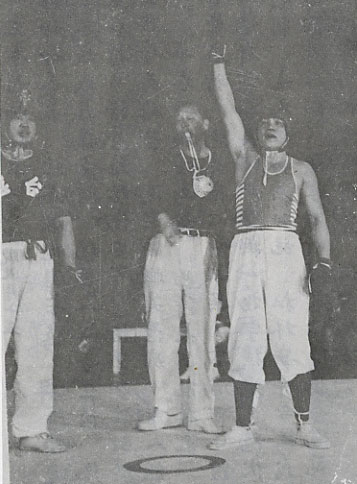
Cheng Tin-Hung - The Martial Art Champion
Wednesday, May 04, 2005
Lower Your Cholesterol and Heal Your Heart
Tai Chi legend Wu Tu-Nan, who was strong and formidable even before he passed away at the age of 108, recommended a simple way to both lower your Cholesterol and heal your heart. Here are the three simple steps:
- Practice Tai Chi 10 or more minutes a day.
- Focus on your middle finger.
- Use the middle finger to lead all the movements.
Tuesday, May 03, 2005
A Frog Starring at the Sky
Is this a common misconception of our world caused by our bias or non-open mindedness? Most people practicing Tai Chi nowadays are limiting what they believed to be Tai Chi. Most of us even believed that TC is great, but if I am really into a fight, I will use my Karate, boxing, or jujitsu. What’s your limiting view of Tai Chi?
Thursday, November 04, 2004
There is only one type of Tai Chi
“This is like learning Chinese calligraphy and Chinese painting. In the beginning, we have to imitate the technique and method of the old masters. Once we are getting better and have our own understanding of the art, we will perform the same art differently without even knowing about it. However, even when their techniques have reached the highest level of the art, each movement still adheres to the same basic tai chi chuan principles.” (The Tai Chi Chuan of Wu Jien Chuan, 1935)
In fact, all great Tai Chi masters of the old time have had a close relationship with each other. Sometimes, they would even voluntarily take on challenges from other schools of martial arts for their friends.
Sunday, October 31, 2004
Halloween with a Tai Chi Sword

When I got there, since it was still an early Sunday morning, there were only a few old couples doing their morning ritual – walking in the park. I found a good spot and started practicing my sword in the morning breeze. The sun was so warm and soothing that I felt like I was in a dream, with my Chi extending through the blade of my sword. I tried not, or not to, find a word to describe my feeling…effortlessly. In fact, this is what life is supposed to be.
However, we always try too hard to understand something that is supposed to be so simple and direct. Moreover, we forget that we all have a sword that can fight off all types of distractions, frustrations, illusions, and negativities in life effortlessly, and become
One
With
The
Tao.
Thursday, October 28, 2004
Tai Chi FAQ - What is Tai Chi?
The proliferation of Tai Chi (Taiji) and the Internet has resulted in numerous viewpoints and explanations of the basic meaning of Tai Chi. Originally, Tai Chi came from the I-Ching, which is one of the oldest books in ancient China. According to the I-Ching, “Tai Chi gives birth to two Yi.” The words “Tai Chi” literally means the “ultimate”, and the two “Yi” represents the “Ying” and “Yang.”
In Chinese culture, Tai Chi is refered to as Tai Chi Chuan. Although the literal meaning of “Chuan” is “fist,” the actual meaning is martial arts. Hence, Tai Chi is the martial art that concentrates on the study and application of both the Ying and Yang. However, even though Tai Chi is a deadly martial art, it is a way of life. “The ultimate meaning of Tai Chi practice is to expand your life span without aging while maintaining a youthful body at the same time.” (The Tai Chi Classics)
Here are some common definitions of Tai Chi that I have found in the Internet.
“Also Known as TAI CHI CH’UAN, and is part of the Tai Chi Ch’uan System, which, originally, was a formidable martial art operating on several levels of awareness. It embodies Taoist Philosophy, and accordingly is extremely beneficial to good health. Tai Chi is a comprehensive series of gentle physical movements, and breathing techniques, with mental and spiritual intent, which allows you to experience a meditative state. It is calming and rejuvenating, and assists the body and mind to maintain balance, and exercises the body, mind and spirit, together with the internal organs. It includes both the inner and outer expressions of the body and mind. Here we are able to balance the Yin and Yang life force energy of Chi. In this way this system develops the ability to balance the “yielding and attacking” aspects in martial art combat. It has also been such a major influence in all the martial arts we see today.”
http://healersoftheworld.com/glossary/glossaryR-U.html
“A Chinese system of physical exercises designed especially for self-defense and meditation.”
“Chinese system of slow meditative physical exercise designed for relaxation and balance and health”
http://www.thefreedictionary.com/tai%20chi
“Tai chi chuan is a style of kung fu that consists of fluid, graceful standing movements. Often called the "moving meditation," it emphasizes softness over hardness, a concern with things internal rather than external, yielding over confrontation.”
http://health.discovery.com/centers/nutritionfitness/
fitness/articles/techniques/taichi/taichi.html
Wednesday, October 20, 2004
Sunday, October 17, 2004
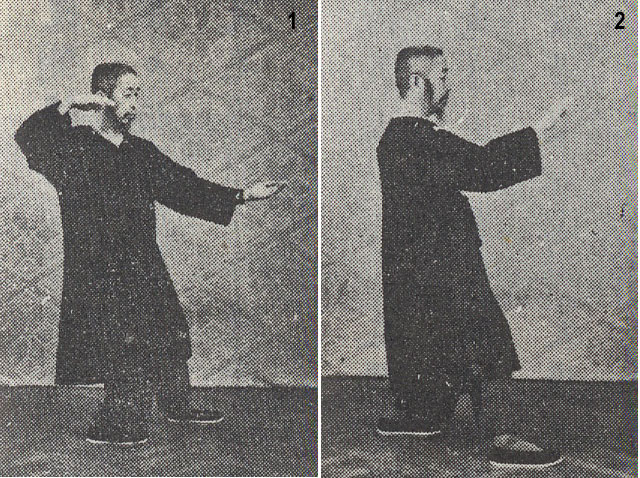
Wu Style Self-Defense Demonstration -- "Repulse Monkey" Technique
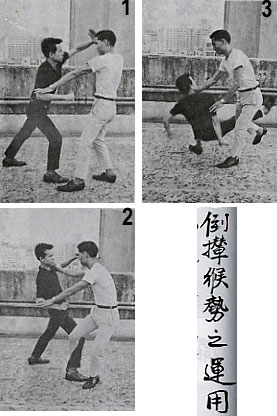
- If my opponent attacks me with a left and right punch combination, I will use my right hand to “ward-off” his left hand, use my left hand to “push” his right wrist, and move my right foot quickly to the front of my left side. (Picture 1)
- After I put my left leg to the back of my opponent’s left leg, I will kick back using my right heel while using my right arm to attack his chest at the same time. (Picture 2 and 3)
- Please remember that the movement of the hand, foot, waist, and the entire body should be at the same speed to be effective.

