News from Hong Kong has confirmed master Cheng’s death on May 7, 2005 in his Tai Chi Mansion in China. Tai Chi circle has forever lost one the best gladiators of our time. Although he was not well known in the US, his fighting skill is highly appreciated in the Far East and Europe. Even the Chinese government has invited him to advise on how to implement fighting tournament in China.
Although I know that Tai Chi is a way of life or a path of self-realization, I am sadden by the fact that a number of his students has deviated from Master Cheng’s original teachings while they have NOT reached the skill level of master Cheng. In addition, most of the books that he had co-authored in the west are mostly direct translation from his Chinese books.
One word of caution for master Cheng’s inner circle is to avoid fighting for being his successor like in the case professor Cheng Man-Ching. Right after professor passed away, some of professor’s student used legal action to took over Professor Cheng’s dojo and expelled the students hand-picked by professor to run his dojo if he was in Taiwan.
Friday, May 13, 2005


Wednesday, May 11, 2005
Who Killed Professor Cheng Man-Ching
Professor Cheng left a legacy behind when he passed away at the age of 75. However, his death also raised questions about his immortality, Tai Chi skill, and the correctness of his teaching. Although Wolf Lowenthal insisted that Professor Cheng had prepared for his death by hand picking his successors in his New York dojo before he went back to Taiwan, so much rumors had aroused overshadowed this notion.
I asked about professor’s death when I was on a trip to Taiwan. Most people reiterated what a professor at the National Taiwan University had told me - professor was poisoned. In his book Steal My Art, T.T. Liang also recalled the incident and advocated that professor was in fact being poisoned. The stroke that led to his death was caused by his failure to recover from the poison. If this is true, the questions remained are who wanted to kill professor, what was the motive behind the killing, and who was involved?
I asked about professor’s death when I was on a trip to Taiwan. Most people reiterated what a professor at the National Taiwan University had told me - professor was poisoned. In his book Steal My Art, T.T. Liang also recalled the incident and advocated that professor was in fact being poisoned. The stroke that led to his death was caused by his failure to recover from the poison. If this is true, the questions remained are who wanted to kill professor, what was the motive behind the killing, and who was involved?
Tuesday, May 10, 2005
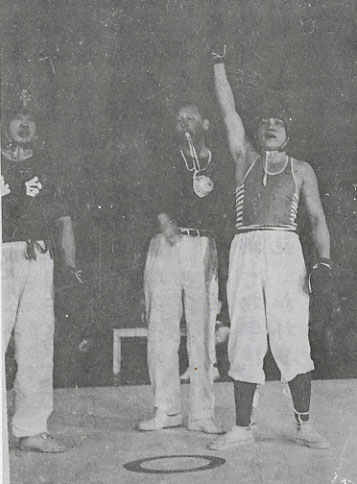
Cheng Tin-Hung - The Martial Art Champion
An old photo of Cheng Tin-Hung taken after he had won the martial art championship in Taiwan.

Wednesday, May 04, 2005
Lower Your Cholesterol and Heal Your Heart
Heart decease has become the number one killer of our age. Unlike a decade ago, most health care practitioners agreed that diet and exercise are, in additional to medical treatments, also extremely important in the combat against heart attack.
Tai Chi legend Wu Tu-Nan, who was strong and formidable even before he passed away at the age of 108, recommended a simple way to both lower your Cholesterol and heal your heart. Here are the three simple steps:
Tai Chi legend Wu Tu-Nan, who was strong and formidable even before he passed away at the age of 108, recommended a simple way to both lower your Cholesterol and heal your heart. Here are the three simple steps:
- Practice Tai Chi 10 or more minutes a day.
- Focus on your middle finger.
- Use the middle finger to lead all the movements.
Tuesday, May 03, 2005
A Frog Starring at the Sky
A long time ago, a frog look into the sky from the bottom of a well said to himself, “The sky is limited. Why do I have to bother?” -- Chuang Tze
Is this a common misconception of our world caused by our bias or non-open mindedness? Most people practicing Tai Chi nowadays are limiting what they believed to be Tai Chi. Most of us even believed that TC is great, but if I am really into a fight, I will use my Karate, boxing, or jujitsu. What’s your limiting view of Tai Chi?
Is this a common misconception of our world caused by our bias or non-open mindedness? Most people practicing Tai Chi nowadays are limiting what they believed to be Tai Chi. Most of us even believed that TC is great, but if I am really into a fight, I will use my Karate, boxing, or jujitsu. What’s your limiting view of Tai Chi?
Thursday, November 04, 2004
There is only one type of Tai Chi
According to Yang Cheng Fu, the teacher of Professor Cheng Man Ching, he taught the same type of tai chi that had been handed down from the Chen family. Wu Jien Chuan, the son of the founder of Wu style Tai Chi, also expressed the same idea. You may be wondering how that could be possible, as students and teachers alike, from different styles of Tai Chi such as Chen, Yang, Wu, Sun, and Dong, are promoting the differences between the styles and even the idea of one being superior to another. Wu Jien Chuan best explains the difference in his book about Wu style Tai Chi as the following:
“This is like learning Chinese calligraphy and Chinese painting. In the beginning, we have to imitate the technique and method of the old masters. Once we are getting better and have our own understanding of the art, we will perform the same art differently without even knowing about it. However, even when their techniques have reached the highest level of the art, each movement still adheres to the same basic tai chi chuan principles.” (The Tai Chi Chuan of Wu Jien Chuan, 1935)
“This is like learning Chinese calligraphy and Chinese painting. In the beginning, we have to imitate the technique and method of the old masters. Once we are getting better and have our own understanding of the art, we will perform the same art differently without even knowing about it. However, even when their techniques have reached the highest level of the art, each movement still adheres to the same basic tai chi chuan principles.” (The Tai Chi Chuan of Wu Jien Chuan, 1935)
In fact, all great Tai Chi masters of the old time have had a close relationship with each other. Sometimes, they would even voluntarily take on challenges from other schools of martial arts for their friends.
Sunday, October 31, 2004
Halloween with a Tai Chi Sword
“Sunrise, sunrise. Looks like mornin' in your eyes,” The voice of Norah Jones’ relatively new song popped up in my mind early in the morning. Yeah, today is Halloween and I had an urge to take my Tai Chi sword to play in the park.

When I got there, since it was still an early Sunday morning, there were only a few old couples doing their morning ritual – walking in the park. I found a good spot and started practicing my sword in the morning breeze. The sun was so warm and soothing that I felt like I was in a dream, with my Chi extending through the blade of my sword. I tried not, or not to, find a word to describe my feeling…effortlessly. In fact, this is what life is supposed to be.
However, we always try too hard to understand something that is supposed to be so simple and direct. Moreover, we forget that we all have a sword that can fight off all types of distractions, frustrations, illusions, and negativities in life effortlessly, and become
One
With
The
Tao.

When I got there, since it was still an early Sunday morning, there were only a few old couples doing their morning ritual – walking in the park. I found a good spot and started practicing my sword in the morning breeze. The sun was so warm and soothing that I felt like I was in a dream, with my Chi extending through the blade of my sword. I tried not, or not to, find a word to describe my feeling…effortlessly. In fact, this is what life is supposed to be.
However, we always try too hard to understand something that is supposed to be so simple and direct. Moreover, we forget that we all have a sword that can fight off all types of distractions, frustrations, illusions, and negativities in life effortlessly, and become
One
With
The
Tao.
Thursday, October 28, 2004
Tai Chi FAQ - What is Tai Chi?
The proliferation of Tai Chi (Taiji) and the Internet has resulted in numerous viewpoints and explanations of the basic meaning of Tai Chi. Originally, Tai Chi came from the I-Ching, which is one of the oldest books in ancient China. According to the I-Ching, “Tai Chi gives birth to two Yi.” The words “Tai Chi” literally means the “ultimate”, and the two “Yi” represents the “Ying” and “Yang.”
In Chinese culture, Tai Chi is refered to as Tai Chi Chuan. Although the literal meaning of “Chuan” is “fist,” the actual meaning is martial arts. Hence, Tai Chi is the martial art that concentrates on the study and application of both the Ying and Yang. However, even though Tai Chi is a deadly martial art, it is a way of life. “The ultimate meaning of Tai Chi practice is to expand your life span without aging while maintaining a youthful body at the same time.” (The Tai Chi Classics)
Here are some common definitions of Tai Chi that I have found in the Internet.
“Also Known as TAI CHI CH’UAN, and is part of the Tai Chi Ch’uan System, which, originally, was a formidable martial art operating on several levels of awareness. It embodies Taoist Philosophy, and accordingly is extremely beneficial to good health. Tai Chi is a comprehensive series of gentle physical movements, and breathing techniques, with mental and spiritual intent, which allows you to experience a meditative state. It is calming and rejuvenating, and assists the body and mind to maintain balance, and exercises the body, mind and spirit, together with the internal organs. It includes both the inner and outer expressions of the body and mind. Here we are able to balance the Yin and Yang life force energy of Chi. In this way this system develops the ability to balance the “yielding and attacking” aspects in martial art combat. It has also been such a major influence in all the martial arts we see today.”
http://healersoftheworld.com/glossary/glossaryR-U.html
“A Chinese system of physical exercises designed especially for self-defense and meditation.”
“Chinese system of slow meditative physical exercise designed for relaxation and balance and health”
http://www.thefreedictionary.com/tai%20chi
“Tai chi chuan is a style of kung fu that consists of fluid, graceful standing movements. Often called the "moving meditation," it emphasizes softness over hardness, a concern with things internal rather than external, yielding over confrontation.”
http://health.discovery.com/centers/nutritionfitness/
fitness/articles/techniques/taichi/taichi.html
Wednesday, October 20, 2004
Sunday, October 17, 2004
Wu Style Self-Defense Demonstration -- "Repulse Monkey" Technique
On page 157 of “Tai Chi Chuan” by Cheng Tin-Hung, an application of the “Repulse Monkey” technique is provided as the following:
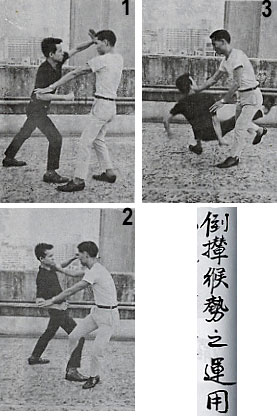
- If my opponent attacks me with a left and right punch combination, I will use my right hand to “ward-off” his left hand, use my left hand to “push” his right wrist, and move my right foot quickly to the front of my left side. (Picture 1)
- After I put my left leg to the back of my opponent’s left leg, I will kick back using my right heel while using my right arm to attack his chest at the same time. (Picture 2 and 3)
- Please remember that the movement of the hand, foot, waist, and the entire body should be at the same speed to be effective.
Grandmaster Cheng Tin-Hung in Action - Repulse Monkey
Here is the Wu Style "Repulse Monkey" demonstrated by Grandmaster Cheng Tin-Hung.


Wednesday, October 13, 2004
Softness and Hardness
Nothing in the world is more soft and weak than water
But for attacking the hard and strong
Nothing can surpass it.
And therefore nothing can take its place.
That the weak can overcome the strong
And the soft can overcome the hard
Is well known to the world
Yet no one can carry it out...
--- Lao Tze

But for attacking the hard and strong
Nothing can surpass it.
And therefore nothing can take its place.
That the weak can overcome the strong
And the soft can overcome the hard
Is well known to the world
Yet no one can carry it out...
--- Lao Tze

Tuesday, October 12, 2004
Great Britain to adopt Tai Chi for curing Heart Disease?
Tai Chi masters and doctors from Asian countries have stated all along that practicing Tai Chi diligently will improve or heal cardiovascular disease. In response to a recent study published in the American Journal of Medicine, which supports this claim with patients showing better movements and reduced BNP levels, a measure of heart failure, the British Heart Foundation said that the UK could adopt Tai Chi as a treatment in the future.
Sunday, October 10, 2004
Tai Chi in Daily Life
Wolfe Lowenthal, a student of Professor Cheng Man-Ching and author of two books on Tai Chi, once told me about a real life application of the Tai Chi principle. About ten years ago, Wolfe bought a new house in the MA area. Since it was his first major investment for a long time, he was overwelmed by the process of house hunting, price negotiation, mortgage application, and the settlement of the house, which involved much frustration and tons of legal paperwork. He realized that even a long time Tai Chi expert like himself could be affected by the stress of daily life, but he also realized that his training in Tai Chi would be of great help to this situation. He said, “I need to sit back and practice my (Tai Chi) Kung Fu to counter the stresses building up.
Professor Cheng always said that the goal of learning Tai Chi is to learn the Tao and that we must live the Tai Chi way even when we are walking, sitting, living, and lying down. The question comes down to this: how many of us can actually remember to sit back and relax, like Wolfe Lowenthal did, when a problem arises?
Professor Cheng always said that the goal of learning Tai Chi is to learn the Tao and that we must live the Tai Chi way even when we are walking, sitting, living, and lying down. The question comes down to this: how many of us can actually remember to sit back and relax, like Wolfe Lowenthal did, when a problem arises?
Friday, October 08, 2004
Tai Chi for Criminals: Santa Fe Lawbreakers Sentenced to Tai Chi Classes
While most people in the Tai Chi world are arguing which style is more effective in fighting or is more suitable for health purposes, Judge Frances Gallegos is putting a new spin on anger management in Santa Fe, New Mexico. She is now offering Tai Chi and meditation to people with domestic violence cases. This is a clear example that Tai Chi’s basic idea of letting go and non-resistance are gaining more and more popularity and understanding from the outside world. But here comes the real question: How many of us can actually apply these principles in our daily life? I would love to hear some real success stories.
Thursday, October 07, 2004
Grandmaster Cheng Tin-Hung on Fighting – 1
(Note: This is the beginning of a series of my translation of Chapter 14 of Cheng Tin-Hung’s 1965 book "Tai Chi Chuan")
Before applying any practical technique in the moment of conflict, one must pay special attention to the on-guard position, in additon to preparing your mind psychologically. In this position, you will be able to watch every small detail of your opponent, and be able to both attack and defend with ease. Hence, one should not just stand unprepared while waiting for the fight to begin, as this will hinder both the ability to attack and retreat.
Before the fight, the distance between your opponent and yourself must exceed four feet as it would be difficult to counter a sudden attack if you are too close to your opponent.
Your mind must be focused without any stress, and you must treat it as if it is a normal practice. Pay attention to any small detail, so that your can understand both the direction of an attack and whether the attack is just a deception. You must be able to do this before you can deflect an attack and apply a counter attack.
Although the goal of fighting is to let go, follow your opponent’s actions while avoiding the Yang and attacking his Yin, your mind must always remain alert and ready to change technique according to the situation. Use your brain, not your force.Once you gain an advantage, you must follow your opponent and keep attacking to maintain this advantage until you win the conflict. If you cannot maintain your advantage, and let your opponent have a come back, you will then have to start the fight over again. This way, it’s hard to predict the victor.
Tuesday, October 05, 2004
Tai Chi for Health -- According to the Masters
Tai Chi has started gaining momentum as a miraculous curer of all sorts of health problems. A quick search of the term “Tai Chi for Health” in Google® has turned up 271,000 results. According to Dr. Weil, one of the U.S. gurus in alternative health:
“Tens of millions of Chinese do tai chi every morning on sidewalks and in parks, while waiting for buses. I don't know about miraculous cures from this practice, but I think it is great for overall health. It's an excellent relaxation technique, and a way to harmonize the musculoskeletal and nervous systems. It develops concentration, better balance, and coordination. Clinical studies show that it can reduce the risk of falls in the elderly. And if you buy into the Chinese philosophy that illness results from blocked energy flow, then tai chi would be a way to improve the functioning of every system of the body.”
What did the Tai Chi masters have to say about the health benefits? Here are some answers:
- The Tai Chi Classics – “The ultimate meaning of Tai Chi practice is to expand your life span without aging while maintaining a youthful body at the same time.”
- Yang Lu Chan (Founder of Yang family Tai Chi) – “In order to improve the health of Chinese to protect the country, I have learned Tai Chi…. After I have started teaching Tai Chi, I quickly noticed the changes in my students: those who were skinny became strong, those overweighed became normal, and those who were sick became healthy.”
- Wu Jen Chuan (Son of the founder of Wu family Tai Chi) – “Tai Chi achieves wellness from both body and mind…. Anyone with depression, low red blood count, indigestion, and any alignments related to internal organs, bones, and tendons, can be recovered through the practice of Tai Chi. People with incurable medical problems will also achieve unexpected results.”
- Professor Cheng Man-Ching: “I have recovered from incurable tuberculosis in less than a month by practicing Tai Chi.”
- Wu Tu-Nan (Devoted student of Wu Jen Chan and Yang Shao Hou): Born with genetic neurological disorder, tuberculosis, and hepatitis. Tai chi did not just make him strong and formidable, but in fact, he was still teaching Tai Chi two years before he died in 1988, at the age of 108.
Monday, October 04, 2004
Grandmaster Cheng Tin-Hung in Action
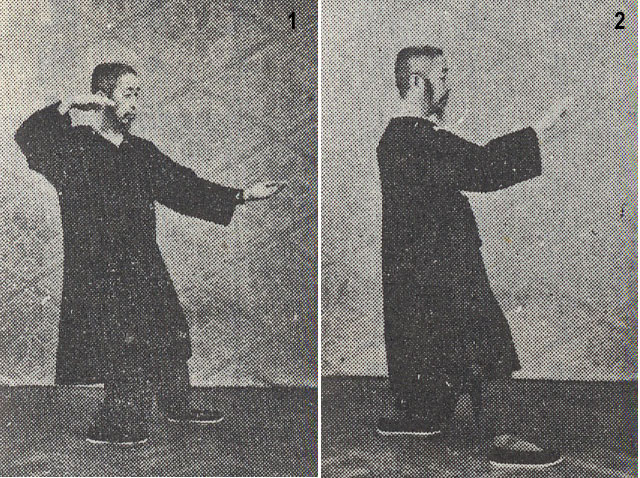
This is a demonstration of the usage of the Tai Chi technique called "Single Whip."


Sunday, October 03, 2004
You Must Be Kidding, Tai Chi is a fighting art?
Let’s ponder what the late Bruce Lee had once said about Tai Chi for a moment – “Tai Chi has proven to be an excellent fighting act in history and Yang Lu Chan (the founder of Yang family Tai Chi) has proven Tai Chi is a deadly fighting art.” However, when we think about Tai Chi, most people will automatically associate an image of a bunch of old fellows moving slowly and gracefully in the park. Indeed, Tai Chi has become a new age phenomenon with its usage ranging from stress reduction to improvement of wellness. What has been forgotten from the equation is the martial art aspect of Tai Chi.
One must be wondering, “How can this slow-motion technique be useful in real fighting, especially against other styles which stress lightning speed and deadly techniques? Give me some proof.” For example, here are two western Tai Chi masters who have won full contact martial arts championships without even a scratch.
- Peter Ralston – Peter, a student of William C.C. Chen, was the first non-Asian to win the 1978 World Tournament.
- Dan Docherty – Dan, a student of Cheng Tin-Hung, won the 1980 open weight division of the South-East Asian Chinese Pugilistic Championship after a few years of Tai Chi training.
Friday, October 01, 2004
Welcome
This is the first kick-off post for this Tai Chi Blog. Tai Chi, also sometimes called Taiqi, or Tai Chi Chuan, is an excellent martial art with tremendous health benefits. This blog will try to cover both the health and fighting aspects of the art, news about the field, reviews on books and DVDs, oral transmission of Tai Chi masters, and walkthroughs of both training and application of the art.
Subscribe to:
Posts (Atom)

